


Dreamforce 2026: From AI Headlines to Production Reality

%20Medium.jpeg)
Another Dreamforce is in the books, and this one had a very different energy to previous years. Between the keynotes, the industry roundtables and, most valuably, the conversations with customers and partners, one message came through clearly: enterprise AI is moving from experimentation to execution.
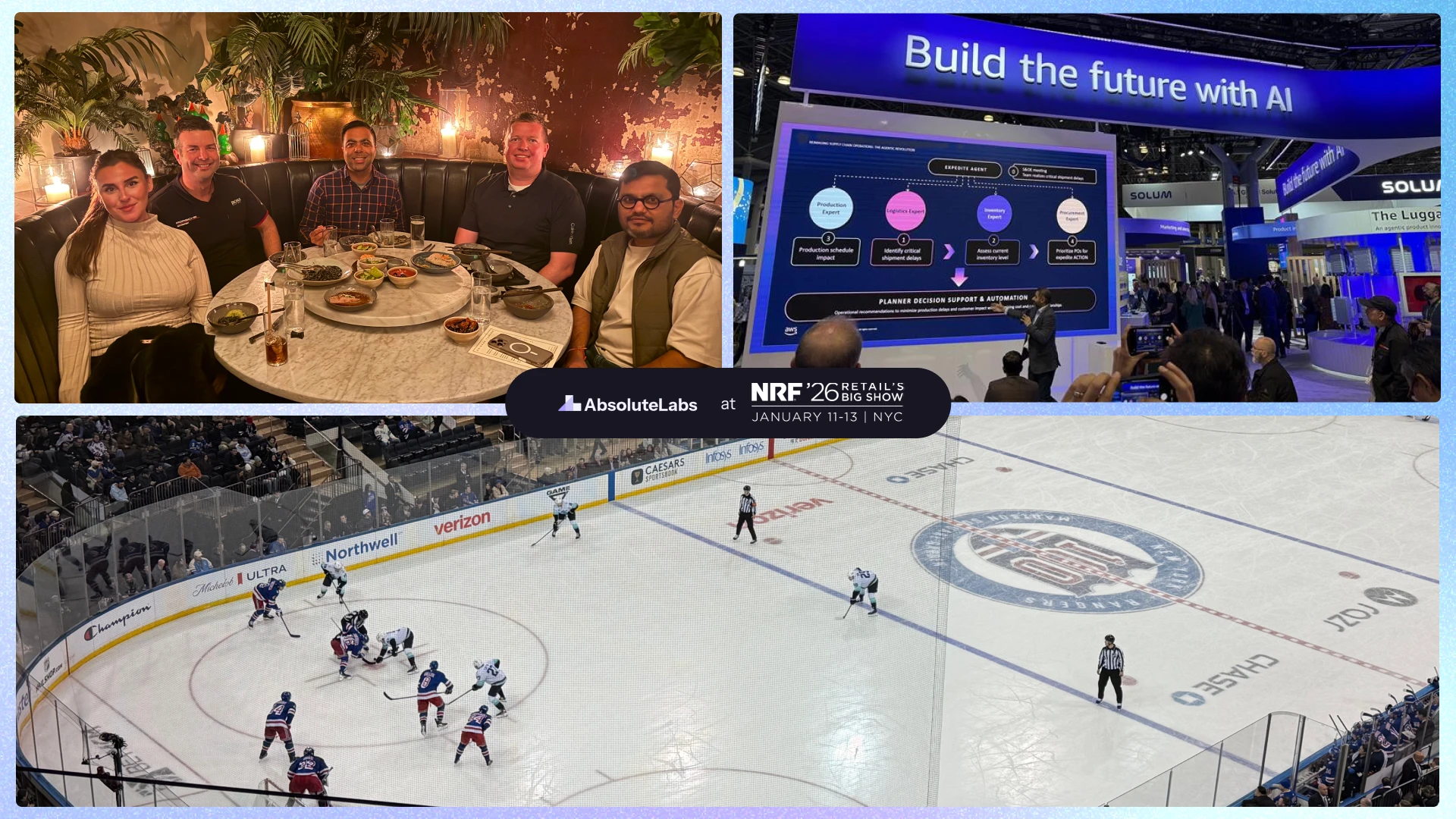
AbsoluteLabs spent the week in San Francisco: three days on the show floor, dozens of client and partner conversations, and two events of our own away from the conference halls, including an intimate dinner with clients and Salesforce colleagues at The Palm Court at RH, and an evening of drinks co-hosted with our partners Inardua and Forter at Shelby's Rooftop, bringing together around 75 Salesforce colleagues, partners and prospects. Here is what stood out.
The big theme: ambition needs an execution plan
"“As a result of our ambition, and with the productivity boost we get from AI,
the sky's the limit.”
Jensen Huang, NVIDIA
It is a line that captures where the industry is heading. Yet the conversations that stayed with us were less about how high AI can go and more about what it takes to get there: how an agent moves from a good idea into a production system that a business relies on every day.
Appetite for AI is not the problem. McKinsey's State of AI 2026 found that nearly nine in ten organisations now use AI regularly, yet only 44% are scaling it across the enterprise and just 37% can point to any impact on EBIT. The harder part is readiness: a clear strategy and roadmap, governance designed in from the start, data that is fit for purpose, and teams who are equipped and confident to use what is being built.
Data is often where it stalls. Gartner found that 63% of organisations either do not have, or are unsure whether they have, the right data management practices for AI. Ambition without that groundwork tends to produce a collection of pilots rather than a change in how the business runs.
That question of readiness ran through every industry conversation we had.
Manufacturing: from connected assets to agentic operations
Manufacturers have spent years connecting products, assets, ERP, CRM and service platforms. The opportunity now is to make that data actionable. The use cases that stood out were proactive maintenance, intelligent field service, warranty automation, partner and distributor enablement, quoting and autonomous customer service. For manufacturers, the opportunity is much bigger than deploying a chatbot. It is about connecting CRM, ERP, product and asset data with service history, and letting agents run meaningful operational processes on top of it.
Siemens CEO Roland Busch put it simply on the main stage: “Hallucination does not really work on the shop floor.” For industrial businesses, AI only earns trust when it is grounded in accurate product, asset and service data.
%20Medium.jpeg)
Retail: AI needs to move closer to the transaction
Retail conversations have moved well beyond personalised marketing. The exciting territory now spans the whole customer journey, from AI powered product discovery and conversational commerce to loyalty, clienteling, customer service, order management, returns and the post purchase experience. Agentic commerce could fundamentally change what we think of as the digital storefront.
The shift is already measurable. Adobe reported that traffic from AI sources to US retail sites grew 393% year on year in the first quarter of 2026, and McKinsey estimates agentic commerce could orchestrate $900 billion to $1 trillion of US retail revenue by 2030.
That change means retailers now have two audiences to win over: the shopper, and the AI agents that increasingly shape what that shopper discovers, considers and buys. Building for both, without losing sight of the human experience that earns loyalty in the first place, is quickly becoming part of the same customer strategy rather than a separate technical project.
Consumer goods: connect planning with execution
Consumer goods conversations were particularly relevant to the work we do. There is enormous opportunity to connect commercial planning, field sales, trade promotion, retail execution, customer service and data, rather than running them as separate processes that do not talk to each other.
Financial services: trusted AI embedded into the customer lifecycle
Financial services was another rich area of discussion, with AI opportunity spanning customer onboarding, KYC, servicing, lending, claims, relationship management, financial advice and back office operations.
Across every one of these, the same pattern held. The organisations that get this right will not simply have more AI. They will redesign how work gets done between people, data, applications and agents. The evidence backs this up: McKinsey found that 72% of AI high performers have fundamentally redesigned workflows, compared with 25% of other organisations.
Four developments worth watching beyond the AI headlines
Marc Benioff was joined by Jensen Huang, Anthropic's Dario Amodei and Roland Busch, and the message was consistent: AI needs to meet people where work already happens. AIforce brings trusted customer data, workflows and business rules into tools like Claude, Slack and Lightning, while Koa, a new CRM reasoning model built with NVIDIA, is designed for more complex, multi step work. Just as important was the emphasis on trust, permissions and governance, which are fast becoming as important as the models themselves.
Away from the keynote soundbites, a few product and platform announcements stood out as especially consequential for retail, consumer goods and manufacturing leaders.
Commerce is moving beyond the retailer's website
CommerceCloud can now send product catalogues directly to Google, and from October its UCP integration is expected to support checkout through Gemini and GoogleSearch, including AI Mode, with payments, compliance and order management still running on the retailer's own commerce infrastructure. In practice, this means product data, pricing and inventory now need to be accurate across external AI channels, not just the retailer's own site.
The stakes are high. A digital shelf can offer almost endless choice, but an AI agent may only recommend a handful of products. Product pages are also where retailers are least ready: Adobe's analysis found they are the least readable part of retail websites for AI systems. Being accurately represented and understood matters well before agent led purchasing becomes mainstream, and it makes product data part of the growth strategy rather than a back office task.
Consumer Goods Cloud is targeting field productivity and accuracy
Winter '27 introduces more accurate field order calculations and enhancements to trade promotion management, alongside voice assisted Retail Execution. Field representatives can capture visit information and kick off follow up actions using natural language while they are still in the store. Less admin means more time in the field, and better order and promotion accuracy protects revenue and margin.
MuleSoft is addressing control across multiple agents
AgentFabric brings a registry, broker, governance controls and visibility for agents built across different platforms. Enterprises are going to be running agents from several vendors at once, and they will need a way to control how those agents interact with commerce, OMS, ERP and supply chain systems, and to prevent duplicate or unauthorised activity.
Agentforce Operations moves into the back office
Agentforce Operations coordinates work involving documents, approvals, people and disconnected systems. On the main stage, Siemens showed an agent learning its SAP supplier onboarding process in a safe sandbox before running it autonomously, completing certification, financial and risk checks before creating the supplier in SAP. Salesforce and Siemens expect this to simplify supplier onboarding from weeks to days. The demo also named the point where many AI projects hit a wall: getting agents to work reliably inside back end systems. The opportunity extends well beyond customer service, into supplier onboarding, purchase order changes, fulfilment exceptions, claims and compliance.
The thread running through all four is that not every process needs an agent. Commerce, OMS and ERP should keep running predictable transactions exactly as they do today. AI earns its place where work involves unstructured information, multiple systems and manual investigation.
Getting AI into production is as much about people as it is about technology. BCG's 10 20 70 rule suggests that only 10% of the effort in an AI transformation should go on algorithms and 20% on technology and data, with the remaining 70% on people and processes. Adecco CEO Denis Machuel made the same point on stage, describing a shared vision that “AI had to happen with people and not to people.”
What's next
Every Dreamforce sets out an ambitious vision, and this year was no exception. At AbsoluteLabs, our focus is on what comes after the keynote: turning that vision into production use cases that deliver measurable value, built on the data, governance and people foundations that make AI stick. If any of the themes here are on your roadmap for 2027, we would love to continue the conversation.
.jpg)



.jpg)



.jpg)


.jpg)


.jpeg)



